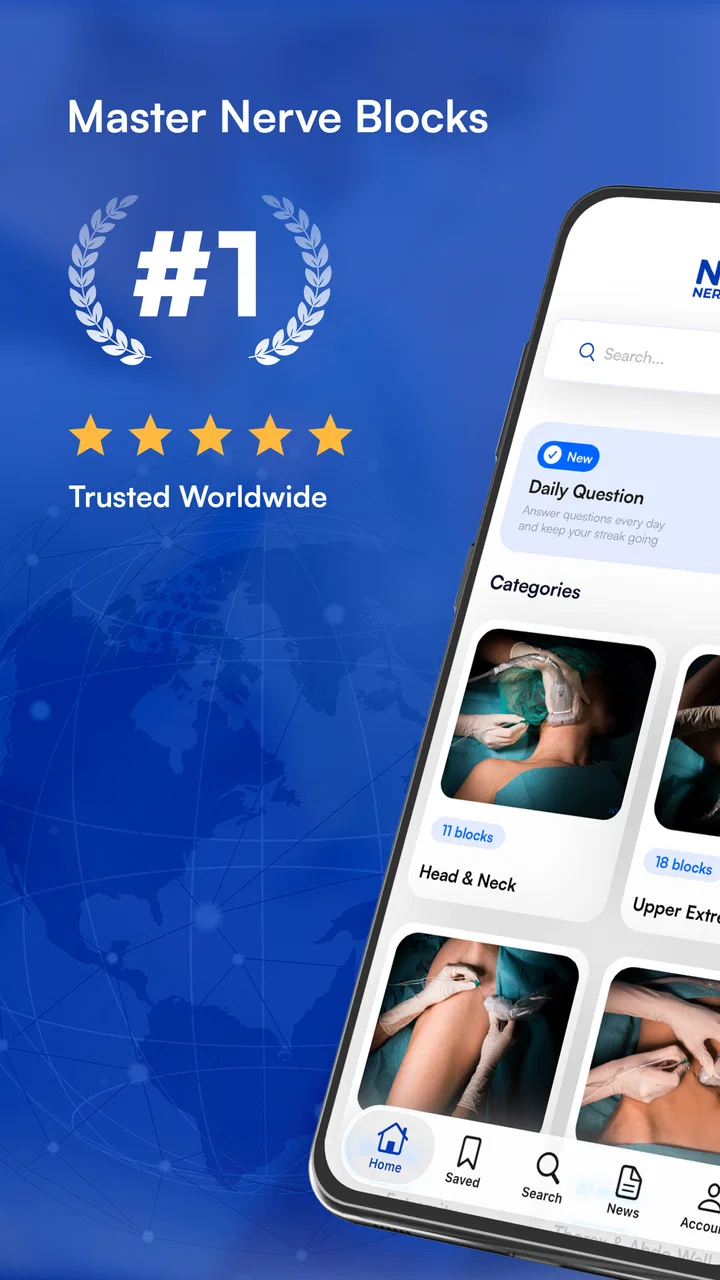
NYSORA Nerve Blocks
- 4.2
- Rating
- 100.00K
- Installs
- Free
- Price

 Analysis by App-foxy
When I need a focused reference for ultrasound-guided nerve blocks, I want something I can consult without turning a quick preparation task into a long search through unrelated material. NYSORA Nerve Blocks is built for that exact medical-learning situation. It comes from NYSORA.INC and presents itself as a practical reference rather than a general health app, so its value depends on whether your work or study involves regional anesthesia and ultrasound-guided techniques.
I approached it as a clinician or trainee might: start with a block I need to review, find the relevant anatomy and technique guidance, use the material to prepare for a discussion or procedure, and then decide whether the app is useful enough to keep nearby. That workflow reveals both its strength and its limits. It can make a specialized subject easier to revisit, but it should be treated as a reference companion, not as a substitute for supervised training, institutional protocols, or patient-specific clinical judgment.
From a clinical question to a usable reference
The starting condition is usually simple but time-sensitive. Perhaps I am preparing for a teaching session, revising regional anesthesia before a rotation, or trying to refresh the logic behind an ultrasound-guided nerve block. A broad medical search can produce too much material, while a paper textbook may be authoritative but slow to navigate when I need a particular topic. This app is more useful in the middle ground: it narrows the subject to nerve blocks and gives me a dedicated place to review the concepts around them.
You May Also Like

 Blood Strike: 2.5 Anniversary
Blood Strike’s Loadouts Turn Every Drop Into a Tactical Gamble
A close look at Blood Strike’s custom loadouts: how fast access to signature weapons reshapes its battle royale rhythm, rewards preparation, and narrows the gap between fights.

 Pandora - Music & Podcasts
Pandora’s Music Is Easy to Start, but Harder to Recover
Pandora’s strength is its low-effort path from a seed to a station. Its weak spot is how much confidence it asks you to place in connection, setup, and quiet recovery.

 8 Ball Pool
 Is Built on Rivalries, Rematches, and Routine
A close look at the rivalries, rematches, shared routines, and unanswered safety questions that turn a quick pool match into a persistent mobile community.

 Samsung Music
’s Quiet Strength Is Playing What You Already Own
Its reach comes less from spectacle than from dependable access to a personal library. That simplicity is both the app’s strongest retention engine and its ceiling.

 AccuWeather: Weather Radar
AccuWeather Review: A Quick, Clear Forecast for Everyday Decisions
For everyday plans, the best forecast is the one you can understand quickly. AccuWeather makes rain timing, radar, and local conditions easy to act on, with a few trade-offs.

 Hill Climb Racing
Why Hill Climb Racing Still Turns Crashes Into One More Run
A tiny car, a bumpy hill and one more upgrade: Hill Climb Racing keeps resurfacing because its simple chaos makes every near-miss feel personal.
More From Our News Desk



That focus is also the first important trade-off. Someone looking for medication reminders, symptom checking, appointment management, or general patient education will not find the right tool here. This is a specialist medical reference. Its practical audience includes anesthesia learners, clinicians who already understand the clinical context, and educators who want a compact aid for discussion. A complete beginner may still benefit from the terminology, but should not mistake a concise reference for a full introductory course.
The app is free to install and is suitable for Everyone in the store’s age classification, but that age label should not be confused with clinical suitability for unsupervised use. Medical content can be accessible to a wide audience while still requiring professional training to apply safely. I would be comfortable recommending it as a study aid; I would not recommend using it as the sole basis for performing a block.
Choosing the right moment to open it
One of the less obvious benefits of a narrow reference app is that it changes how I prepare. Instead of opening a general browser and comparing scattered pages, I can begin with the specific nerve block or anatomical region I am trying to understand. That reduces the mental cost of getting started. The app’s store summary describes it as a practical and authoritative guide to ultrasound-guided nerve blocks, and that positioning matches the kind of task it serves best: targeted revision rather than broad medical browsing.
My advice is to open it before the clinical encounter, not for the first time while a patient is waiting. I would use it to refresh terminology, organize questions for a supervisor, and identify which anatomical relationships deserve closer attention. That workflow creates a useful handoff from private preparation to supervised clinical discussion. The app can support the conversation, but the responsibility for technique, patient selection, consent, equipment, monitoring, and local practice remains with the qualified team.
Working through a block step by step
A sensible review session starts with the name of the block and then moves outward: what region is involved, which structures matter, and how ultrasound changes the way the anatomy is interpreted. I find this more productive than memorizing isolated labels. The point of a reference like this is not merely to recognize a nerve name; it is to connect the target with the surrounding anatomy and with the practical reasoning required during scanning.
For a learner, the best approach is active rather than passive. I would first try to describe the anatomy from memory, then consult the relevant material, and finally explain the approach aloud as if teaching another person. That three-stage loop turns the app from a reading screen into a preparation tool. It also exposes uncertainty quickly. If I cannot explain why a structure matters or how I would distinguish it from a nearby structure, I know that I need supervision or a more detailed source.
A second useful workflow is comparison. After reviewing one block, I would deliberately contrast it with a nearby or commonly confused approach. The goal is not to create a memorized checklist from the app, but to notice how anatomy, patient position, probe orientation, and the intended distribution of local anesthetic influence the plan. This is where a specialized reference can outperform a generic search: the surrounding context is more likely to stay within the language of regional anesthesia.
Still, I would keep a separate notebook or approved clinical resource for details that must match local policy. A mobile reference may help me remember the conceptual sequence, but local standards govern issues such as preparation, monitoring, rescue planning, documentation, and dosing. That separation is an important safety habit. Use the app to prepare questions and structure thinking; use institutional guidance and qualified supervision to make clinical decisions.
Turning reading into a handoff
The most realistic use case is not one person reading in isolation. Imagine a trainee preparing for a teaching case before joining an attending anesthesiologist. The trainee reviews the relevant block, notes the anatomy that remains unclear, and arrives with specific questions. During the handoff, the supervisor can correct the interpretation, adapt the plan to the patient, and explain how the local workflow differs from the learner’s expectations.
That is a stronger use of the app than showing a screen and asking, “What do I do?” The handoff should include the patient’s actual indication, relevant history, contraindications, examination findings, equipment, and the supervisor’s preferred technique. The reference supplies background; the clinical team supplies context. I appreciate tools that encourage that distinction, because a polished diagram or concise explanation can otherwise create false confidence.
Educators may also find value in using the app as a prompt for discussion. Rather than treating every page as a final answer, an instructor can ask the learner to identify the target, describe the expected sonoanatomy, and explain what could make the image difficult to interpret. The app then becomes a shared starting point for reasoning. That is a more durable learning outcome than simply scrolling through a technique description.
There is another handoff that matters: the handoff from study material to the patient conversation. A clinician still needs to explain the proposed procedure in language the patient understands, including what it is intended to achieve, possible alternatives, and relevant risks. Specialist terminology from a nerve-block reference should never be copied directly into patient counseling. I would use the app to improve my own preparation, then translate the information into a clear, patient-centered explanation.
What the finished workflow gives me
The result is a more organized preparation process. I can move from a focused question to an anatomy review, then to a list of points for supervision. That is the app’s clearest practical contribution. It does not need to replace every textbook or course to be useful; it only needs to shorten the path between “I need to refresh this block” and “I know what I need to verify before discussing it.”
Its audience size suggests that this focused approach has found a real audience: the app has passed 100K installs and holds a 4.2 average from around 1.6K ratings. Those figures do not prove that it will suit every clinician, but they indicate that it is more than an obscure experiment. I also noticed that the app has 35 written reviews, so I would place more weight on my own learning needs than on brief public comments when deciding whether to keep using it.
The current version is 4.8.0, and the app supports devices running Android 7.0 or later. That makes it accessible to many older Android phones and tablets, which is useful in a hospital or classroom environment where the newest personal device is not always the one available. I would still test the reading experience on the actual device I plan to use. A reference that feels comfortable on a large screen may be less pleasant when I am trying to study on a compact phone.
For me, the strongest outcome is not memorizing a technique from one session. It is building a repeatable review habit. Before a case, I can identify the block, review the relevant anatomy, write down uncertainties, and carry those questions into supervision. Afterward, I can revisit the concepts and compare them with what I observed. That input-to-outcome loop makes the app more valuable than a one-time browse through a store description.
Where the workflow breaks down
The first point of friction is scope. A dedicated nerve-block guide is helpful precisely because it stays focused, but that means it cannot serve as a complete anesthesia reference. If I need comprehensive perioperative planning, broader pharmacology, emergency management, or a deep discussion of complications, I would reach for a textbook, institutional protocol, formal course, or specialist database instead. The better alternative depends on the question, and no single mobile app should be expected to cover all of it.
The second problem is the risk of overconfidence. Ultrasound-guided procedures are not learned safely through text and images alone. Image acquisition, needle visualization, anatomical variation, patient factors, and real-time judgment all matter. A learner who reads a clear explanation may feel prepared while still lacking the hands-on skill to reproduce it. I would therefore skip this app as a standalone learning path if I had no access to qualified instruction or supervised practice.
There is also a financial boundary to consider. The app is free, but in-app purchases range from $12.99 to $199.99 per item. That does not automatically make it poor value, yet it means I would inspect what is available before assuming the free installation contains everything I need. For an individual learner, the right choice may depend on how often the material will be used and whether a school, department, or library already provides a more comprehensive resource. I would not pay for additional content simply because the subject is specialized; I would first confirm that it fills a specific gap in my workflow.
The app is developed by NYSORA.INC, which gives it a clear connection to a recognizable specialist identity, but a developer name alone should not replace critical appraisal. I would still compare important clinical points with current local guidance and teaching from qualified faculty. This is especially important when a reference influences a real patient encounter, where the patient’s anatomy and medical history may make a standard explanation insufficient.
A further limitation is the difference between quick access and deep study. Mobile references are excellent for short review sessions, but they can encourage fragmented learning. If I keep jumping between topics without testing my understanding, I may recognize terms without being able to reason through a case. My workaround is to use the app in short, deliberate sessions and follow each one with recall, discussion, or supervised practice. That small change makes the tool more educational and less like passive scrolling.
Who should use it, and who should choose something else
I would recommend it to a medical student exploring regional anesthesia, an anesthesia trainee preparing for supervised teaching, or a practicing clinician who wants a compact refresher on ultrasound-guided nerve blocks. It is particularly suitable for people who already know how to interpret medical terminology and want a focused reference rather than a general health app. The practical orientation can also help an educator structure a conversation before moving to a simulator, ultrasound machine, or bedside teaching.
I would be more cautious recommending it to patients, casual learners, or anyone hoping to perform a nerve block independently. The Everyone age classification describes access, not competence. A patient may use the app to understand why a clinician is discussing a nerve block, but patient education should come from the treating team and should account for the individual situation. Someone seeking broad anesthesia education may also be better served by a structured course with assessments and direct feedback.
If your usual alternative is a general web search, this app is likely to feel more focused and less distracting. If your alternative is a current institutional protocol or a detailed specialist textbook, those sources may be better for decisions that require comprehensive context and local standards. I see the app between those options: faster and more portable than a large reference, but not as complete or authoritative for every clinical decision as the resources used in formal practice.
My recommendation after following the full flow
After moving from a clinical question through review, supervision, and reflection, I see NYSORA Nerve Blocks as a useful supporting tool rather than a complete solution. Its narrow focus is its main advantage. It helps me get oriented, prepare more intelligently, and turn vague uncertainty into concrete questions for an instructor or colleague. That is meaningful value when the subject is specialized and the available study time is limited.
I would install it for targeted revision, especially if I were already involved in anesthesia education or supervised regional anesthesia practice. I would keep a trusted textbook, local protocol, and experienced supervisor in the workflow rather than treating the app as the final authority. The free entry point makes it easy to evaluate, while the optional purchases mean I would check the available material against my actual needs before spending money.
My bottom line: use it to sharpen preparation, not to replace training. If that is the role you want from a medical reference, this app deserves consideration. If you need broad clinical coverage, formal assessment, or step-by-step hands-on instruction, choose a more comprehensive learning resource and let this app play only the focused part it handles best.
FAQs for NYSORA Nerve Blocks
01What is NYSORA Nerve Blocks, and who is it designed for?
NYSORA Nerve Blocks is an educational medical app focused on regional anesthesia and ultrasound-guided nerve block techniques. It is primarily intended for anesthesiologists, anesthesia residents, pain specialists, emergency physicians, and other qualified healthcare professionals. The app is also useful for students and clinicians who want a structured visual reference, but it should not be treated as a substitute for supervised training, institutional protocols, or clinical judgment.
02What type of information and learning materials does the app include?
The app provides practical reference material for performing and understanding various nerve blocks. Depending on the selected technique, users may find anatomy explanations, ultrasound images, probe positioning guidance, needle approaches, indications, relevant landmarks, and safety considerations. Its visual format makes it convenient for reviewing procedures before teaching sessions or clinical practice, although users should confirm that the content matches current guidelines and local standards.
03Can NYSORA Nerve Blocks be used as a guide during a real procedure?
The application can be a helpful point-of-care reference, but it should not be the only source of information during a nerve block. Real procedures require appropriate medical education, hands-on supervision, patient assessment, sterile technique, monitoring, and access to emergency equipment. Users must rely on their professional training, hospital policies, and current evidence. The app is educational and does not replace a qualified instructor or responsible clinical decision-making.
04Is NYSORA Nerve Blocks free to download, and does it require a subscription?
Availability, pricing, and access can vary according to the platform, region, and version of the application. Some educational content may be accessible without payment, while advanced techniques or complete reference libraries may require an in-app purchase, subscription, or account. Before downloading, check the current Google Play or App Store listing for the exact cost, trial terms, renewal conditions, and whether purchases are shared across devices.
05Does the app work offline, and what device permissions or account features are required?
Offline functionality depends on the specific version and the content being accessed. Some downloaded materials may remain available without an internet connection, while videos, updates, account verification, or premium resources may require online access. Users should review the app-store permissions and privacy information before installation. A stable connection is recommended for initial downloads, updates, and synchronization, especially when using the app across multiple devices.
Pros
- Clear
- step-by-step guidance for ultrasound-guided nerve blocks.
- High-quality anatomical illustrations support visual learning.
- Useful reference for anesthesia trainees and practicing clinicians.
- Search tools make specific blocks easier to find quickly.
- Covers practical details such as positioning and needle approaches.
Cons
- Many advanced features require a paid subscription.
- Content may be overwhelming for beginners without clinical supervision.
- Some material assumes access to an ultrasound machine.
- Not a substitute for formal training or hands-on instruction.
- The app is mainly useful to anesthesia and pain-management professionals.

NYSORA Nerve Blocks
Gallery